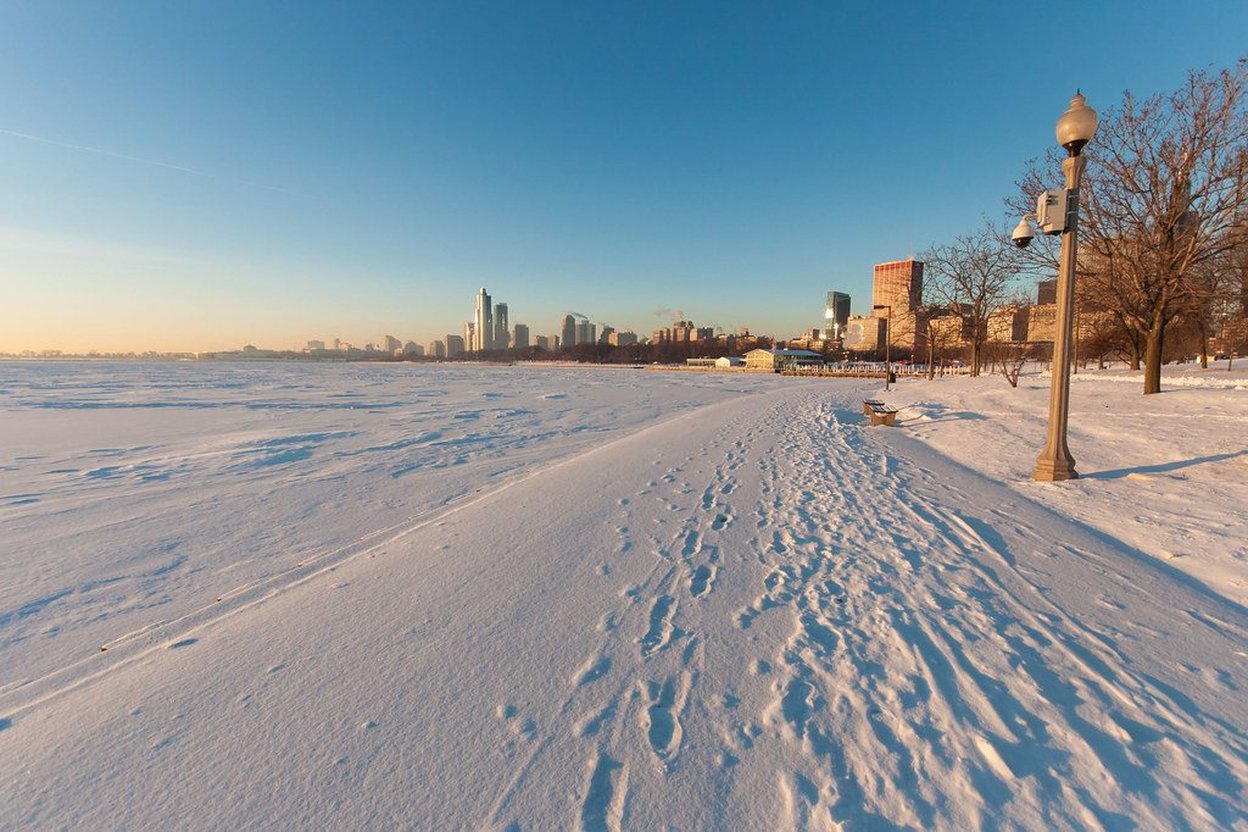
Does the Lakefront Trail Close for Winter? No. Here's What Does Shut It Down
The Lakefront Trail has no winter closing date. Here's what shuts it down: heavy snow, ice and big waves, and where to check before you go.
You've seen the first cold morning off the lake, with the wind coming in hard past the Oak Street curve, and you're wondering whether to put the bike away until spring. You don't have to. The Chicago Park District has no winter closing date for the Lakefront Trail. The trail stays open through the cold months, and the Park District closes all or part of it only when the weather makes it unsafe. Here's what causes those closures, which stretch closes most, and where to check before you head out.
The short answer
The trail doesn't close for the season. The Park District's Lakefront Trail page lists no winter shutdown and no closing date, and it has no winter section at all. On hours, it says only that "the trails are open during normal operating hours."
The trail runs from Ardmore Avenue on the north to 71st Street on the south. Since the 2018 separation project, it has been two trails side by side: an 18-mile bike trail and an 18.5-mile pedestrian trail. Neither one has a season.
Some confusion may come from Wikipedia, which lists the trail's season as "Limited access during winter" and doesn't explain what that means. In practice, "limited" means some days are bad, not that there's a closing date. Wikipedia also says the trail itself is open 24 hours, while the parks and beaches along it close at 11 p.m.
So the real question isn't when the trail closes for winter. It's what closes it on a given day.
What actually closes it
Three things close the trail: heavy snow that drifts, ice, and big waves that throw water and debris onto the path.
The February 2021 blizzard shows how it works. About 18 inches of snow fell on Feb. 15. The next day, the Park District closed the whole trail, from Ardmore to 71st, "until further notice," Streetsblog Chicago reported. A Park District spokesperson said the closures were "due to drifting snow." Crews waited until it was safe for staff to get out there.
Waves can do even more damage than snow. In January 2020, a storm brought gusts over 55 mph and waves up to 20 feet, and several sections of the trail closed for high water, Fox 32 reported. The lake tore up pieces of the asphalt, and crews were still clearing it after parts of the trail reopened.
Closures don't stick to the calendar, either. The Park District posts them as alerts whenever conditions call for it, and that can happen in late fall or at the end of winter. A strong east wind is a better warning sign than the date.
The usual trouble spot
If one stretch is going to close, it's usually the one between North Avenue and Ohio Street, with the Oak Street curve in the middle. There the trail runs right along the water, with little between you and the waves.
It shows up again and again. During the 2021 blizzard, the North Avenue to Ohio Street stretch had been closed for ice before the rest of the trail was shut for snow, and it stayed closed after everything else reopened (Streetsblog). After the January 2020 storm, Fullerton to Ohio reopened on Jan. 13, while crews were still pulling up broken asphalt between Ohio and Oak (Fox 32).
If you commute through the Gold Coast or Streeterville, plan for this stretch to close first and reopen last. Have a backup route on the streets west of Lake Shore Drive ready on stormy days.
Plowing and reopening
The Park District is technically independent of the city, so the trail isn't cleared on the same schedule as your side street. Its crews normally clear the trail the morning after a storm, according to Streetsblog.
Reopening happens one section at a time. In 2021, the trail closed on Feb. 16 and most of it reopened early on Feb. 17, but the North Avenue to Ohio Street stretch stayed closed for ice. In 2020, some sections reopened while crews were still working on others, including 41st to 45th on the South Side, which reopened Jan. 13 (Fox 32).
After a big storm, expect parts of the trail to stay closed for a day or more. Don't assume the whole trail is open because your end of it is.
This fall's repair work
Coming months, you may run into work zones. On Sept. 15, 2026, the Park District posted a Lakefront Trail Maintenance Alert saying that "over the next several months, repairs will be made throughout the trail, one section at a time." Work starts at the south end, around 6300 south, and moves north toward Foster Avenue Beach, "as weather allows."
The work covers asphalt patching and seal-coating, replacing worn-out concrete along the edges, and new trail markings, following a full inspection of all 18 miles. Signs go up ahead of each work zone, and the Park District asks people to stay out of active construction areas. The alert lists no closure dates.
This is repair work, not a winter closure. Expect a detour around a crew, not a locked-up trail.
Where to check before you go
Check the Park District's Lakefront Trail page first. Weather and maintenance alerts appear there, and the same alert banners also show up on the pages for parks along the lake. If a storm came through overnight, especially one with strong east winds, check before you leave, not when you reach the barricade at Oak Street.
Keep the hours in mind as well. The trail itself is open around the clock, but the parks and beaches along it close at 11 p.m. (Wikipedia). Early commutes and late runs on the trail are fine. Hanging around at the beach after dark is not.
Most winter days, the trail is open and almost empty, and those are some of the best days to be on it.
Sources (5)
- Chicago Park District: Lakefront Trail
- Chicago Park District: Montrose Harbor (maintenance alert banner)
- Wikipedia: Chicago Lakefront Trail
- Streetsblog Chicago: The entire Lakefront Trail is still officially closed until further notice (Feb. 17, 2021)
- Fox 32 Chicago: Lakefront trails reopen after winter storm
Photo: Lakefront trail tracks by bradhoc, BY 2.0.