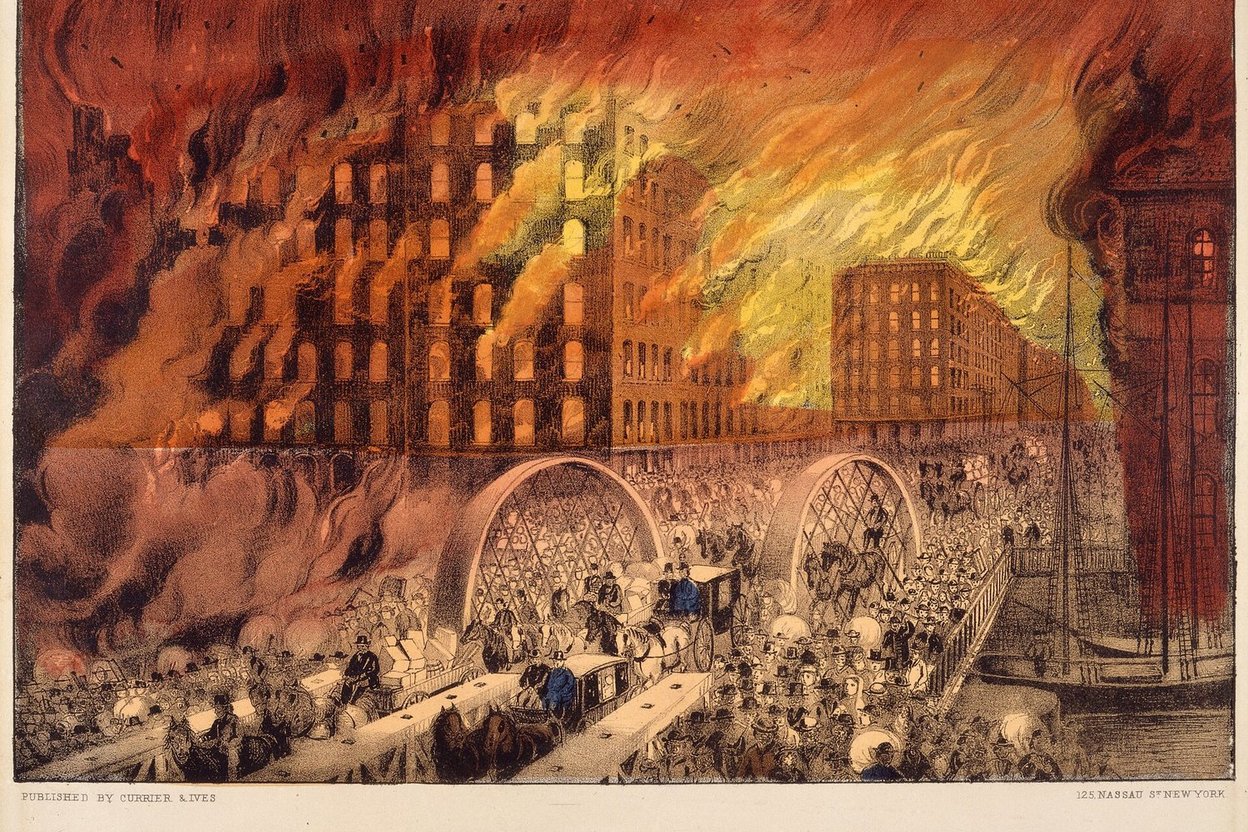
The Great Chicago Fire of 1871: What Really Happened October 8–10
Hour by hour from the O'Leary barn to the rain: how the 1871 fire spread, what it destroyed, what the cow story got wrong, and what you can still visit.
The Great Chicago Fire started around 8:30 p.m. on Sunday, October 8, 1871, in or near Patrick and Catherine O'Leary's barn on DeKoven Street on the city's Southwest Side. A southwest wind pushed it north and east across both branches of the Chicago River. By the time rain fell late Monday night into Tuesday, October 10, it had burned about 3.3 square miles and destroyed more than 17,000 buildings. About 300 people died and more than 100,000 lost their homes. Nobody has ever proven what started it, and it wasn't Mrs. O'Leary's cow.
This Thursday is the 155th anniversary. Here's how those two days went, why the fire got so big, and where you can still stand on the ground it touched.
The city was ready to burn
Chicago in 1871 was mostly wood. The houses, barns, sidewalks and many of the streets were all wood. Then came a drought. The city got about 1 inch of rain between July 4 and October 9 that year.
The fire department was small for a city of roughly 300,000. It had 185 firefighters and 17 horse-drawn steam pumpers to cover the whole city.
And the crews were worn out before it started. On Saturday night, October 7, a fire broke out around 10 p.m. in the boiler room of the Lull & Holmes planing mill on Canal Street. It burned about four square blocks, did close to a million dollars in damage, and more than half the department ended up at the scene. Men worked it into Sunday morning. Less than 24 hours later, the O'Leary barn caught.
Sunday night: everything went wrong
The O'Learys lived at 137 DeKoven Street, which is 558 W. DeKoven today, just southwest of the Loop. Their neighbor Daniel "Peg-Leg" Sullivan was the first to report the fire. Historians have argued about him ever since, because he's also one of the people who could have started it.
The alarm system failed in a string of small ways:
- A resident who spotted the fire couldn't get the key to the nearby alarm box. The pharmacist who held it reportedly wouldn't hand it over.
- The watchman at the courthouse tower, Mathias Schaffer, first took the glow for something else. When he did call it in, he sent engines to the wrong spot, about a mile and a half off.
- An alarm that should have come in to the courthouse never registered.
By the time crews got there in force, the barn fire had spread to the sheds and houses around it, and the wind carried burning embers ahead of the line of fire.
The O'Leary house survived. The wind blew the flames northeast, away from their cottage, so the barn behind it burned while the house stood.
Monday morning: across the river, into downtown
People assumed the South Branch of the river would stop it. It didn't. Around midnight, burning debris blew across the South Branch and set the South Side business district on fire.
From there it moved through downtown, where the hotels, banks, newspapers and stores were. The courthouse cupola came down at about 2:30 a.m. on October 9. Then the fire jumped the main stem of the river and went into the North Side.
The worst blow came when the city waterworks caught fire. With the pumps down, the hydrants went dry and firefighters had no water to work with. All of Monday the fire moved through North Side neighborhoods while people ran for the lake and the open ground of what's now Lincoln Park.
Most of the damage happened on October 9.
Monday night: the rain
Rain started late Monday night and kept up into early Tuesday. By then the fire had mostly burned itself out at the northern edge of town, where it ran out of buildings. The rain put out what was left. One historian put it this way to the Sun-Times: the rain came about 30 hours late.
The burned area ran about 4 miles long and close to a mile wide, and covered the city's whole business district.
The toll
- Dead: about 300. The exact count isn't known, because some bodies were never found.
- Homeless: more than 100,000, about a third of the city.
- Buildings: more than 17,000. Sources put the count anywhere from 17,450 to 17,501.
- Damage: around $200 million in 1871 money. Some estimates run higher.
Mayor Roswell Mason put the Chicago Relief and Aid Society in charge of feeding and housing the people burned out.
The cow story
The cow kicking over a lantern came from the newspapers. In 1893, reporter Michael Ahern said the story was made up. Catherine O'Leary had always denied it, and the official inquiry after the fire never settled the cause.
It stuck to her family anyway. In 1997 the Chicago City Council passed a resolution clearing Catherine O'Leary and her cow. The cause is still listed as unknown. People have put forward theories about Sullivan, about men gambling in the barn, and even about a meteor shower, but none of them has been proven.
Peshtigo burned the same night
Chicago's fire gets the fame, but it wasn't the deadliest fire in the region that night. On October 8, about 250 miles north, the Peshtigo Fire in Wisconsin killed somewhere between 1,200 and 2,500 people and burned roughly 1.5 million acres. It's still the deadliest wildfire in U.S. history. The same dry fall and strong winds fed both.
What you can still see
You can visit a surprising amount of 1871 in an afternoon.
The Water Tower and Pumping Station. These two are the best-known survivors. They stand on Michigan Avenue at Chicago Avenue, so they're on the route of the Magnificent Mile Lights Festival if you want to see them in November.
The site where it started. The Chicago Fire Department built its training academy on the O'Leary property in 1956. Out front at 558 W. DeKoven is Pillar of Fire, a bronze sculpture of stylized flames by Chicago sculptor Egon Weiner, put up in 1961 over the spot where the fire is believed to have started. The site was named a Chicago Landmark in 1971, 100 years after the fire. Today it's the Robert J. Quinn Fire Academy, and it's a working training center, so look from the sidewalk.
St. Michael's Church in Old Town. Its walls made it through, and the church was rebuilt inside them.
Grant Park. Much of the rubble went into the lake shallows between Michigan Avenue and the railroad tracks, and that fill is part of the ground under Grant Park. In 2016 workers there dug up charred bricks, timber and ash. You've probably walked on it at Taste of Chicago.
The city flag. Chicago's flag has four red stars, and one of them stands for the fire.
Why it's on your calendar every October
The National Fire Protection Association started Fire Prevention Week in 1922 to mark the Chicago fire. President Coolidge proclaimed the first national one in 1925, and it still falls on the week that includes October 9. That's why fire departments around Chicagoland hold open houses and hand out smoke-alarm reminders this time of year.
If you want to mark the anniversary this week:
- Stand at 558 W. DeKoven, then walk or drive to Michigan and Chicago Avenue. That's the start of the fire and one of its few survivors, and on the map it shows you how far the wind carried it.
- Use the anniversary as your reminder to check your own smoke alarms. Press the test button on each one, and replace any alarm that's 10 years old or older.
- When someone brings up the cow, tell them the reporter admitted he made it up in 1893 and the City Council cleared her in 1997.
Sources (6)
Photo: Chicago in Flames by Currier & Ives, 1871 by Currier and Ives, Public domain.