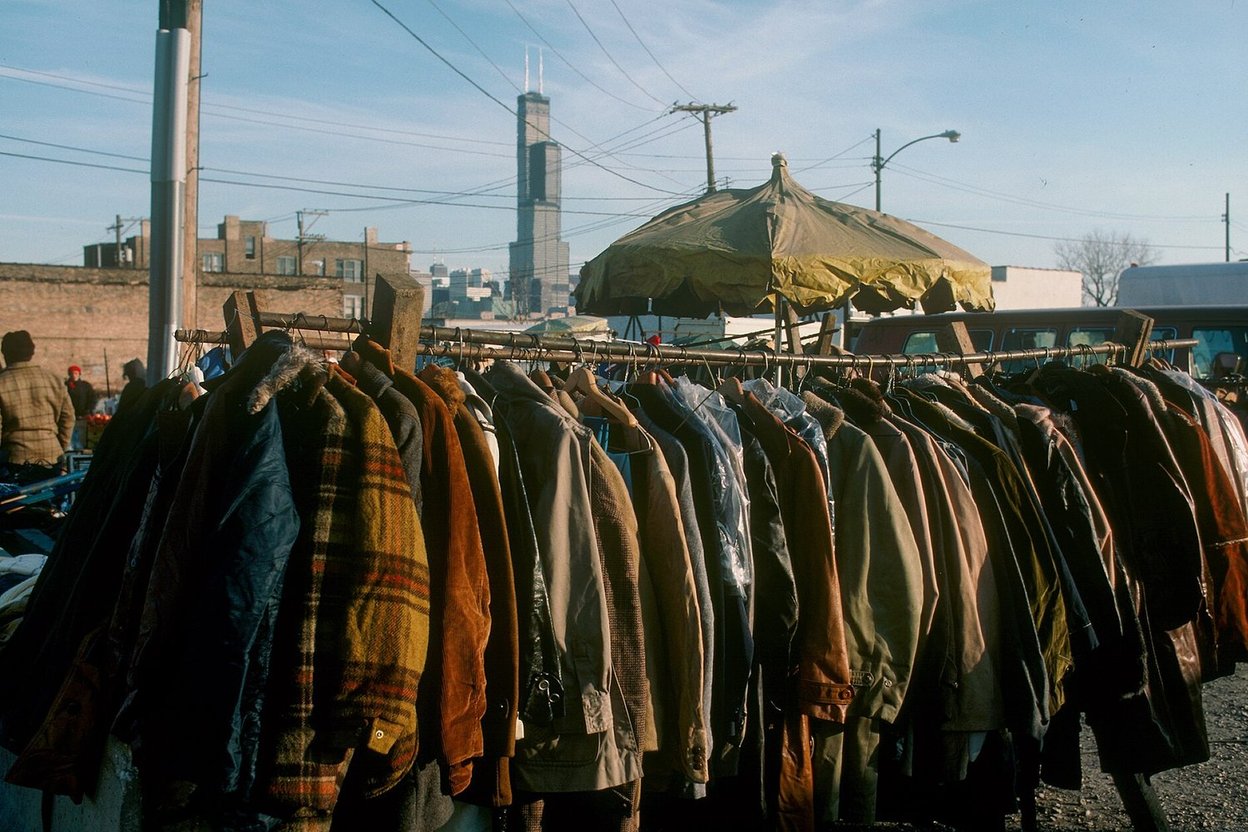
Maxwell Street Market: Polish Sausage, the Blues, and a Market That Keeps Moving
For a century, Maxwell Street was Chicago's open-air bazaar: haggling, street food, and the electric blues. Officially recognized in 1912, moved in 1994, again in 2008. Its history and where it is now.
If you wanted anything in old Chicago, from a hubcap to a suit to a live chicken, somebody on Maxwell Street had it, and you could haggle for it.
The original
The market grew up in the late 1800s around Maxwell and Halsted Streets on the Near West Side, a neighborhood of new immigrants, many of them Jewish families from Eastern Europe. Peddlers sold from carts and stands on the street.
The City of Chicago officially recognized the Maxwell Street Market in October 1912. It became a Sunday tradition, stretching for blocks between Roosevelt Road and 16th Street.
The sound of Maxwell Street
Maxwell Street was where many Black musicians who came north in the Great Migration played for tips, plugged into extension cords from nearby buildings. The amplified, electric Chicago blues grew up partly on those sidewalks. Big names played there before they played anywhere else.
The food
The Maxwell Street Polish, a grilled Polish sausage with grilled onions, mustard and sport peppers, comes from the stands around Maxwell and Halsted. Pork chop sandwiches, bone in, too. A few stands that trace their roots to the old market are still serving.
Moving the market
The neighborhood changed, and so did the market:
- 1994: the city moved the market a few blocks east to Canal Street to make way for the University of Illinois at Chicago's expansion. It became the "New Maxwell Street Market."
- 2008: it moved again, to Desplaines Street.
- In more recent years, it's moved again, with a goal of getting closer to its original home.
Check the city's market page for the current location and season before you go.
What's left
Most of the old Maxwell Street buildings are gone, replaced by UIC. A few historic facades and a historical marker remain, along with the sausage stands.
Why it matters
Maxwell Street was Chicago in one place: immigrants, music, food, and people trying to make a living. Plenty of Chicagoland families have a grandparent who sold or bought something there.
For more Chicago history, see Riverview Park and Marshall Field's.
Sources (3)
City of Chicago: History of the Maxwell Street Market · Block Club Chicago: Maxwell Street Market moving to "original home" (2024) · Wikipedia: Maxwell Street
Photo: Maxwell Street, Chicago, November 1987; photographer, Jeff Wassmann by JDWassmann, CC BY-SA 4.0.