Mill, Dam and Bridge: A Short History of Each Fox River Town
How mills and dams built twelve Fox River towns from Algonquin to Yorkville, and why their downtowns still face the river today.
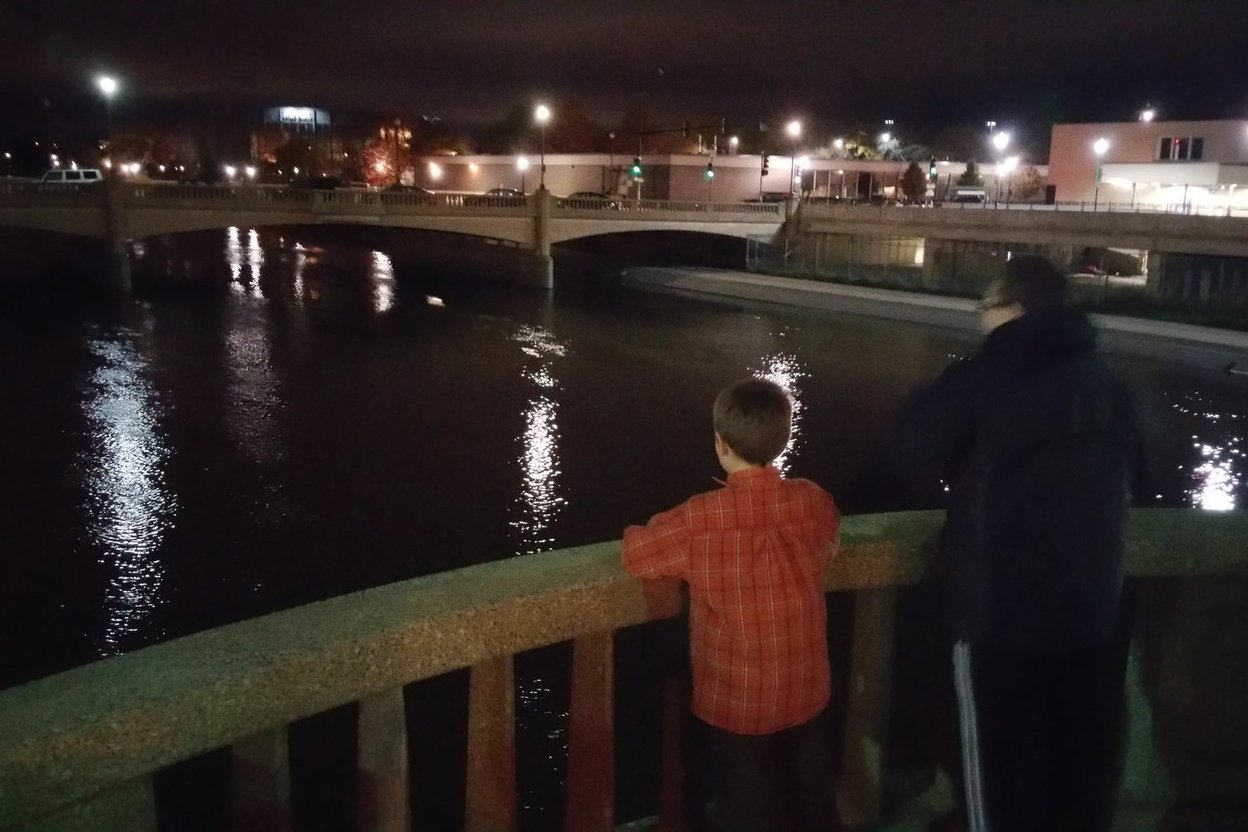
You've probably sat in traffic on a Fox River bridge, glanced down at water churning white over a low dam and moved on. This time of year, with the trees along the bank turning, the river is easy to notice again. That dam and that bridge are why the town is there. From Algonquin south to Yorkville, nearly every Fox River town began as a mill site, a ford or a ferry crossing. Here's a short history of each one, from north to south.
How the river made the towns
The Potawatomi lived along this stretch of the Fox before any of these towns existed. After the Black Hawk War of 1832, American settlers moved down the valley, staked claims and built towns on the river.
The first thing most of them needed was waterpower. Settlers dammed the Fox to run sawmills and gristmills, then built bridges so farmers could reach them. St. Charles had a dam, a bridge, a sawmill and a gristmill finished by 1836, and the other towns followed the same pattern.
Then the railroads came. A line reached Elgin in 1850, and through that decade Elgin shipped trainloads of milk to Chicago. Aurora grew up on the Chicago, Burlington & Quincy. Later, the Aurora, Elgin & Fox River Electric ran an interurban along the river from Carpentersville through the river towns to Yorkville, until passenger service ended in 1935.
The towns, north to south
Algonquin
The village names Samuel Gillilan, a Virginian, as its first permanent settler and dates his arrival to 1834. Early names came from the river crossings: Denny's Ferry and Cornish's Ferry. Algonquin became a trading point for dairy farms and a summer resort for Chicagoans who came to boat and fish. The village's own history calls it the "Gem of the Fox River Valley." After a cheese factory on the rail line burned in 1890, Borden built a condensed-milk plant in town. The village says that plant was the largest employer for several decades, until it was torn down in the 1930s. Residents voted to incorporate on February 25, 1890. Today Algonquin sits on the Fox in both Kane and McHenry counties, and the 2020 census counted 29,700 people. There's still a dam across the river there.
Carpentersville
In the spring of 1837, the Charles Carpenter family arrived from Uxbridge, Massachusetts, and found the Fox in flood. They couldn't cross, so they stayed on the east bank and called the place Carpenter's Grove. Angelo Carpenter later built the first store and a bridge. In 1853 George Marshall opened a reaper shop that grew into the Illinois Iron and Bolt Company, incorporated in the 1860s. Its old factory buildings still stand in Old Town by the river. Carpentersville stayed a small mill town for about a century. That changed in the 1950s, when the Meadowdale neighborhood went up on the east side. The 2020 census counted 37,983 people.
East Dundee and West Dundee
Settlers were here by 1834–35. In 1835 Elder John and Nancy Oatman opened a tavern and store on the west side. In 1837 Alexander Gardiner won a drawing for the right to name the town and picked Dundee, after his home city in Scotland. The river now divides it into two villages.
West Dundee has some famous early residents. Allan Pinkerton, who later became the famous detective, worked as a cooper there starting in 1843. In 1855 William Hill founded the D. Hill Nursery, which grew evergreens that were sent to Chicago for the 1893 World's Columbian Exposition.
East Dundee had brick. David Haeger started Haeger Brick in 1871, and its bricks helped rebuild Chicago after the fire. The company later became Haeger Potteries and closed in 2016 after 145 years. The old railroad bed through town is now the Fox River Trail, and the depot was rebuilt in 1984 as a tourist center. Plenty of readers will remember Santa's Village, which ran from 1959 to 2006 and reopened in 2011 as Santa's Village AZoosment Park. The 2020 census counted 3,152 people in East Dundee.
Elgin
Hezekiah Gifford came in 1834 and returned in April 1835 with his brother, James T. Gifford. They settled on the Fox and named the place Elgin, after a Scottish hymn tune. A dam and grist mills followed by the late 1830s, and Elgin became a city in 1854. The city dates its charter to February 28.
The railroad turned Elgin into dairy country. Gail Borden's condensed-milk plant opened in the 1860s, and the city says Elgin was once called the butter capital of the world. Then came watches. The National Watch Company was organized in 1864, built its Elgin factory in 1866 and finished its first watch in 1867. The plant became one of the largest watch factories in the world. According to the city, production stopped in the early 1960s and the factory was torn down in 1965.
Elgin now has 114,797 people (2020) and sits on both the Fox and I-90, with part of the city in Cook County. Casino gambling, financial services and health care drive the economy today.
South Elgin
South Elgin started out as Clintonville. It grew up around flour mills, a quarry and a gristmill dam on the Fox, and it incorporated as South Elgin in 1897 (the village dates the vote to April 20). Today it's best known for the Fox River Trolley Museum, which runs on a surviving piece of the 1896 interurban line. The museum group incorporated in 1961 and opened to the public on July 4, 1966. On a fall weekend, the trolley along the riverbank is about as close as you can get to riding the old line through the valley.
St. Charles
Evan Shelby claimed the east bank in 1833. In 1834 Shelby, Ira Minard and Read Ferson founded a town they called Charleston, after a town in Ferson's home state of Vermont. Illinois already had a Charleston, so in 1839 the name became St. Charles. By 1836 the town already had its dam, bridge, sawmill and gristmill. Its best-known building sits on that old mill site. Colonel Edward J. Baker built the Hotel Baker at the Main Street bridge, and it opened on June 2, 1928. The city calls itself "The Pride of the Fox," a nickname chosen in a contest.
Geneva
James and Charity Herrington arrived in 1835 on land bought from Daniel Shaw Haight, who had come the year before. The place was called Big Springs, Herrington's Ford and La Fox before it became Geneva. In 1836 it was chosen as the Kane County seat, and the courthouse is still at 100 South Third Street. The city dates a sawmill and a second bridge to 1838. In 1865 Henry and Charles Bennett bought the flour mill and sold Bennett flour under the name Geneva Belle. By 1900 the mill was one of the city's main employers.
Geneva became a village in 1867 and a city in 1887. In 1924 Kate Raftery opened the Little Traveler and helped start the Third Street shopping district. Island Park, on an island in the Fox, was dedicated in 1915 as the city's first park. Today Geneva has about 21,000 people and a downtown of shops and historic houses.
Batavia
Christopher Payne and his family settled here in 1833, at a place called Big Woods, or the Head of the Big Woods. Judge Isaac Wilson renamed it Batavia, after his home in Batavia, New York. After the 1871 fire, local quarries shipped limestone to rebuild Chicago. Batavia's real claim to fame, though, is windmills. It was called the Windmill City, and six companies there built farm windmills from the late 1800s until the industry closed in the early 1950s. The old Appleton factory is now the city and township government center at 100 North Island Avenue, and restored windmills stand near it and along the river.
North Aurora
North Aurora started as Schneider's Mill, also called Schneider's Crossing, after John Peter Schneider, who built a sawmill and a dam on the Fox. The village incorporated in 1905. The dam you see there now was built by the state in 1975. It's a concrete weir 9 feet high, and it sits close to where Schneider's mill dam stood.
Aurora
Joseph McCarty, a millwright from Elmira, New York, claimed both banks of the Fox in April 1834, and his brother Samuel joined him that November. They built a cabin, a dam and a sawmill beside the island that is now downtown, and the mill was running by June 1835. A post office opened in 1837, and the settlement became Aurora.
For a while, Aurora was two towns: East Aurora incorporated in 1845 and West Aurora in 1854. They merged as the City of Aurora in 1857 (February 11, by the city's count). Neither side would let the other have the public buildings, so they went on Stolp Island, in the middle of the river.
On November 8, 1881, Aurora switched on electric street lights, among the first American cities to do so. In 1908 it took the nickname "City of Lights." The Burlington's shops were the city's largest employer until the 1960s. Aurora had 180,542 people in 2020 and is still the second-largest city in Illinois.
Montgomery
The Chicago–Galena road forded the Fox at this spot. Daniel S. Gray, from Montgomery County, New York, built the first frame house in 1836. He dug a mill race, dammed the river and put mills along the race, including a stone flour mill in 1853. That same year he platted land on the west bank. The settlement was called Graystown before it was renamed Montgomery, after Gray's home county. The village dates its incorporation to 1858. Gray's Mill still stands by the bridge, and today Montgomery spans both Kane and Kendall counties.
Oswego
William Smith Wilson and his brother-in-law Daniel Pearce settled in 1833 where Waubonsie Creek meets the Fox. A limestone shelf there made a natural ford. Lewis B. Judson and Levi F. Arnold platted a village they called Hudson, while the post office went by Lodi. In 1837 residents settled the question and chose Oswego, after the city in New York.
The dam powered what became Parker's Mills. The Gorton brothers sold their mill and dam to Nathaniel Rising in 1840, and Rising sold them to William Parker in 1852. Village hall now sits at 100 Parkers Mill. The Little White School, finished in 1850, is the local history museum. The Burlington's Fox River Branch reached town in 1870. Caterpillar opened a plant in Oswego Township in the mid-1950s, and from the 1980s on, new housing spread west from Aurora and Naperville.
Yorkville
Earl Adams built a cabin in 1833 on the south side of the Fox, on the hill later called Courthouse Hill. Across the river was Bristol, where Lyman and Burr Bristol settled in 1834. Yorkville's city history says Rulief Duryea laid out the village in 1836 and named it for New York. Yorkville became the Kendall County seat when the county formed in 1841, lost it to Oswego, later won it back and has kept it ever since.
A mill dam was in place by the late 1830s, and the 1842 plat shows a sawmill marked Howe's Mill Dam. An 1870 account describes a dam powering a paper mill, a gristmill and a sawmill. The city dates the merger of Yorkville and Bristol into the United City of Yorkville to April 16, 1957. The state built a concrete dam in 1960–61 and calls it the Glen D. Palmer Dam.
The river towns today
These towns are Chicago suburbs now, but the old downtowns still face the river, the bridges and the dams. Low dams still cross the Fox at Algonquin, North Aurora, Yorkville and elsewhere. They're the descendants of the mill dams that started each town. Geneva still has the Kane County courthouse, and Yorkville is still the Kendall County seat. Aurora, with 180,542 people, is the big city of the string, and Elgin, at 114,797, is the other.
The easiest way to see all of this is the Fox River Trail. It's paved and links the towns from Algonquin south through Oswego, much of it on old rail beds and along the river roads. A fall ride from St. Charles to Geneva to Batavia takes you past a hotel built on a mill site, a courthouse that has been the county seat since 1836 and a riverbank lined with windmills. If family is in town for Thanksgiving on November 26, a walk across any of these bridges makes a good way to spend the afternoon.
This was the quick version. Each town has more to it than a paragraph can hold, and we'll take them one at a time in upcoming stories.
Sources (64)
- Village of Algonquin: History
- Village of Algonquin: Borden landmark document
- Missouri Census Data Center: 2020 Algonquin
- McHenry County: Census
- Village of Carpentersville: history
- Chicago Tribune: A Second Giant Step
- Wikipedia: Carpentersville, Illinois
- Illinois Municipal League: 2020 census populations
- Village of West Dundee: History
- Village of East Dundee: History
- Daily Herald: Haeger Potteries closing after 145 years
- Wikipedia: East Dundee, Illinois
- City of Elgin: Our History
- City of Elgin: Historic Districts & Landmarks
- Britannica: Elgin, Illinois
- Elgin history video
- Wikipedia: Elgin Watch Company
- Village of South Elgin: Community
- Wikipedia: South Elgin, Illinois
- Fox River Trolley Museum: Our History
- Trains: Fox River Trolley Museum profile
- Wikipedia: Aurora, Elgin and Fox River Electric Company
- City of St. Charles: History
- St. Charles History Museum: Building the Dam, Bridge and Mills
- HMdb: St. Charles marker
- Hotel Baker facts
- City of Geneva: History of Geneva
- Wikipedia: Geneva, Illinois
- Illinois Courts: Kane County Courthouse
- Kane County genealogy: Geneva
- Wikipedia: Batavia, Illinois
- Batavia Historical Society: Batavia history (archived)
- City of Batavia (archived)
- ASME: How Batavia and Its Windmills Helped Settle the American West
- The Free Library: Batavia holds tight to title
- Village of North Aurora: Community
- Wikipedia: North Aurora, Illinois
- Illinois DNR: North Aurora Dam strategic planning study
- Daily Herald: How Aurora emerged in the 1830s
- HMdb: Aurora marker
- City of Aurora: post office anniversary post
- Twain's Geography: Aurora, Illinois
- Illinois Land and Homes: Aurora history
- Aurora Historical Society: The Quest to Light Aurora's Streets
- HMdb: City of Lights marker
- Chicago Tribune: Aurora keeps its standing as 2nd largest city
- Beautify Data: Illinois 2020 city rankings
- Village of Montgomery: History
- Encyclopedia of Chicago: Montgomery
- HMdb: Gray's Mill marker
- History on the Fox: Inside the Fox River's mills from Montgomery to Yorkville
- Village of Oswego: History
- Village of Oswego: document
- Little White School Museum: Oswego History
- Little White School Museum: Oswego Timeline
- Oswego, Illinois (Wikipedia mirror)
- United City of Yorkville: History of Yorkville
- United City of Yorkville: Community Profile
- Wikipedia: Yorkville, Illinois
- Illinois DNR: Yorkville Dam
- Kendall County: Bristol 1870 business directory
- Wikipedia: Fox River Trail
- Enjoy Illinois: Fox River Trail
- Operation of Stratton and Algonquin Dams